
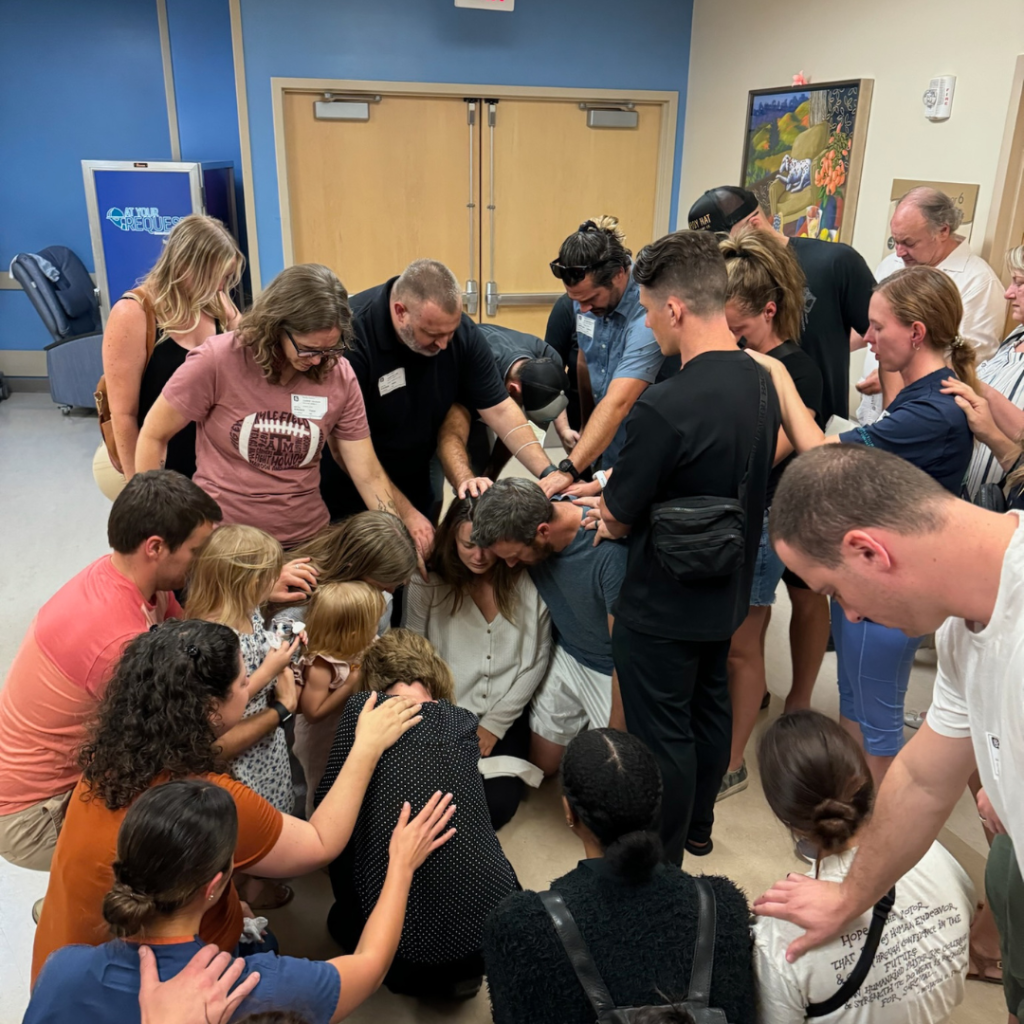
Child loss is an incredibly difficult burden, not only on the family but also on friends and family in any sort of proximity. The fear of doing or saying the wrong thing can paralyze you. You don’t want to do something to make the pain worse. We not only become fearful about screwing up, but we also become fearful of the grave reality childloss unveils – all of us are vulnerable and we are not in control of our lives. Death forces us to come face to face with the vulnerability of life.
How in the world do you support the people you love through such a darkness when you yourself are full of different fears?
I think the answer is simpler than people think. It’s uncomfortable, but it’s simple.
Run toward the suffering.
Jesus models this for us over and over again. He reaches out and touches the ostracized leper to heal him. He interrupts an entire funeral service to restore the child back to his mother. He crosses the sea to free the legion of demons from the Gerasene man.
He sees the suffering, has compassion on them, and then he goes to them. He speaks to them of their pain. He touches their broken bodies. He is a man aquainted with sorrow because he touched it in many people. He looked the blind man in the eye and sat face to face with brokenness. He stood at the tomb of his friend and wept with His grieving friends. As He watched and held our sorrows they became his. God’s compassion as He saw the world broken by sin, led him not only to outstretch his healing hand, but also to the cross. As we watch His compassionate love, if we are disciples of Jesus, it should become ours. Compassion is costly to the one giving the comfort.
Allow your compassion to move you into spaces of darkness. Yes, you may be uncomfortable. Yes, it will cost you something. But you will be more human in your drawing close and giving of yourself to the sufferer than you will if you instead allow your fear to drive you away.
Here’s the truth, you cannot fix this, but you can lighten the burden.
But what can this look like? How do you actually run toward the suffering?
These are ways our community has run toward us and their brave compassion has been a balm to our souls.
- Listen and ask questions
Sitting in grief is really difficult. Hearing the pain of a mother or father who has lost their child isn’t easy. It is heavy. It can shake you. Please, be willing to listen to us weep and ask big questions. Don’t feel like you have to have an answer. Your presence is enough.
Though listening and being present is helpful, pair it with good questions. Ask us to tell you about our child. Ask us about memories while we were pregnant. Ask us our birth story. If our child lived after birth, ask us about the hours or days following it. Ask us what we’re processing through today. Ask us if we have visited their grave recently. Ask us what’s hurting. Ask us what someone has done that’s been helpful.
You can always caveat these questions by saying, “If you don’t want to talk about it right now that’s totally fine, but if you’re willing to share I’d love to hear about ____.”
- Something is always better than nothing
You are not going to do this perfectly. You may worry you’ll say the wrong thing, and at some point, you probably will. You are human. Saying the wrong thing is recoverable. Not saying or doing anything only brings separation and causes harm. Communicate your care, even if it’s just in simple ways.
I remember being pregnant with Gemma, and another family in our church who recently lost their daughter sat near us. I chose to not say anything that day in fear that I would make it worse. That sweet sister is now a dear friend and I regret not going to her that day to acknowledge her daughter, and her and her husbands pain.
Our friends often send texts
- “Thinking of Gemma and your family today.”
- “Wishing Gemma was with you today.”
- “We speak Gemma’s name in our home.”
- “This needs no response. I just wanted to say that I prayed for you while I was ___”
- “I see you honoring your baby. You’re a good mom/dad”
- “Wish I could hug you right now.”
- “We shed tears for Gemma and you all today.”
- “I don’t know what to say but I just wanted you to know I’m thinking of Gemma and your family.”
These are simple and easy ways to communicate your care to your loved ones who have lost a child. If you can’t think of something more to say, don’t overthink it. Something is always better than nothing.
- Offer specific help
Oftentimes, well-meaning friends and family ask the grieving “What can we do to help? Let me know!” Honestly, we don’t know what would be helpful and we don’t have the energy to think of 20 different things for all the people who have asked this. We know you love us and want to help, but we aren’t fully able to process what we need in the weeks or months following the loss of our child.
We have had a handful of people offer to help in a particular way. These people are the people who lighten our burden dramatically. Here are some of the things they have done for us.
- Laundry: one woman in our community who we weren’t super close with has offered a couple of times that on a specific day, she would pick up our laundry and do it for us. This has proved an immeasurable gift. She’s also incredible at folding things very nicely.
- Organization: One friend said they were good at organization and offered to come to help me organize the house. She has consistently done this with me. We purge toys together, organize kitchen cabinets, etc. It also allowed her to be in my home when I needed to reschedule a doctor’s appointment, so she watched my older children.
- Meals: If there is a mealtrain for the family, join it. Sign up more than once and check back in to see if more dates have been added. I’m not sure we would have made it without the dozens of people who have shown up and delivered food. Ask the family if they want company or just a meal drop-off. If you are out of town, we have had several friends order us a meal for delivery at a certain time.
- Cleaning: We were blessed by a loved one who ordered a cleaning service for us for several months. I cannot tell you how helpful this is. But if that is too much, offer to come sweep and mop the floor, clean the kitchen, vacuum and even clean the toilets.
- Yard Work: A family at our church who owns a landscaping company has done our yardwork for a couple of months. You don’t have to own a business to mow lawns and pull weeds.
- Art: Many friends have ordered jewelry with Gemma’s name or birthstone on it. Others wrote songs or poems. A couple of friends have drawn beautiful pieces of art in honor of Gemma. If you are artistically gifted, these things are so special and communicate an incredible amount of care.
- Smoothies: Offer to drop off a smoothie for lunch. It can be hard to eat normally in grief. They may say no, but offer it! It lets them know you care and will make space for them in your schedule.
- Workouts: Friends have sent me their workout schedules, and though I haven’t taken them up on this yet, I have really appreciated this.
- Care Packages/Gifts: We have come home several times to care packages on our doorstep or in our mailbox. Sometimes they are for our children and sometimes for us. These are filled with snacks, crafts, pictures, prayers, journals, books, gifts etc.
- Childcare: If the grieving family has living children offer to watch them so that the parents can spend time together, go to counseling, and attend grief groups. Losing a child is one of the biggest stressors on a marriage. Offering a night, or even better a regular time each week or month, for the parents to connect is such a gift. Sometimes, living siblings need consistency after a loss, so even if the parents don’t accept help rimmediattely, continue to offer it in the coming weeks and months following the family’s loss as the children settle in.
- Finances: Many times child deaths come with large medical bills. Funerals are expensive. Childloss is traumatic and counseling is often necessary. Sometimes ordering doordash is just what weeping parents need. Financially supporting the grieving may not be flashy, but it is helpful.
- Remember to reach out on important dates
As the days, weeks, months, and years wear on the world keeps moving, and that’s as it should be. Remember that the grievers are moving too, but they are carrying a burden. Remind them that they don’t have to carry it alone by remembering and reaching out to them on important dates like monthly birthdays, death dates, Mother’s Day, Father’s Day, Thanksgiving, and Christmas. Let them know you still remember their child, you see the burden they carry, and that what happened still matters to you too.
- Show them your tears
The ministry of tears is a real thing. When I have sat down with people, or even in passing had a quick conversation, and they tear up, it is helpful. You are not burdening the griever with your tears (as long as they don’t have to pick you up off the floor.)
One Sunday at church, I sat in the very back row with arms crossed. My leap of faith that day was just being at the church when I didnt want to be. A friend saw my silent tears during worship and simply walked over, wrapped her arms around me, and wept aloud with me. When worship was finished, she said nothing, squeezed me and went back to her seat.
Your tears tell them that the loss of their child has affected you deeply too. It tells us that our child is important. It communicates love, compassion, and tenderness. The griever isn’t alone in the darkness anymore when the tears of compassion flow on the face of the person across from us.
- Say their child’s name
This is a balm to the grieving parent’s soul. We don’t get to hear our child’s name like other living children. You may be hesitant and fearful that this could hurt them more. Rest assured, we are already thinking about our children. We remember them everyday. Bringing them up is a gift to us and a song for our ears. You could say “I was thinking of Gemma and …”
- Ask them about today or right now
Though “How are you doing?” is an okay question to ask, I’ve found it more helpful when people ask me how I’m doing in the moment. Each day has an extremely wide range of emotion. I may be doing okay in the moment, I may not be. Another question could be “How heavy is your grief today?” and then offer something to maybe bring some relief (cup of coffee, a walking companion, prayer on the spot).
- Keep showing up even if they don’t respond
You may think if the grieving don’t respond that they don’t care or appreciate your reaching out. Let me assure you, they do. They just may not have the capacity in the moment to respond. Grief is a full-time job, and it’s a job we are doing 24/7 even if it looks like we are doing okay. One day, they will respond. The people who continue to reach out without getting a ton of response are the people I begin to feel safest with because they care enough even when they don’t get the satisfaction of a response. Their empathy and compassion remain even when I’m silent and too weary to respond.
- Give them grace and permission to grieve how they need to
Losing a child is also losing a future. There is a lot to work through and how we are doing changes sometimes moment to moment. If you are inviting them to an event, let them know its okay if they don’t know until the day of if they come or not. If they are out with you and all of a sudden need to go home, let them know you understand.
I remember right after Gemma died we went out to eat with friends who were in town for her funeral. In the middle of dinner I started to break down and said I needed to go home. I’ve never seen people pack up and pay a bill so fast. My friend placed her hand on my back the whole way to the car and kept pace with me. I felt understood and protected.
Holidays are another place where you can extend extra grace as the grieving are missing their child. The holidays arent as magical in light of grief, and doing them without the child they expected to be there is difficult. Sometimes holiday plans need changed completely or even cancelled. This can be very difficult for extended family, but offering the grace and flexibility for the grieving is a great way to be supportive in a very dark season.
This is a lot. Even if you just pick one or two of these things and commit to doing them consistently and well, you can make a difference in the life of a grieving parent
A child has been lost. You cannot fix this, but if you allow your compassion to move you toward the suffering, the burden of grief can spread across many shoulders.
So be brave, run toward the suffering and practice a costly compassion that has hands and feet.


 A Mother's Lament
Leave a reply to Akirah Cancel reply